
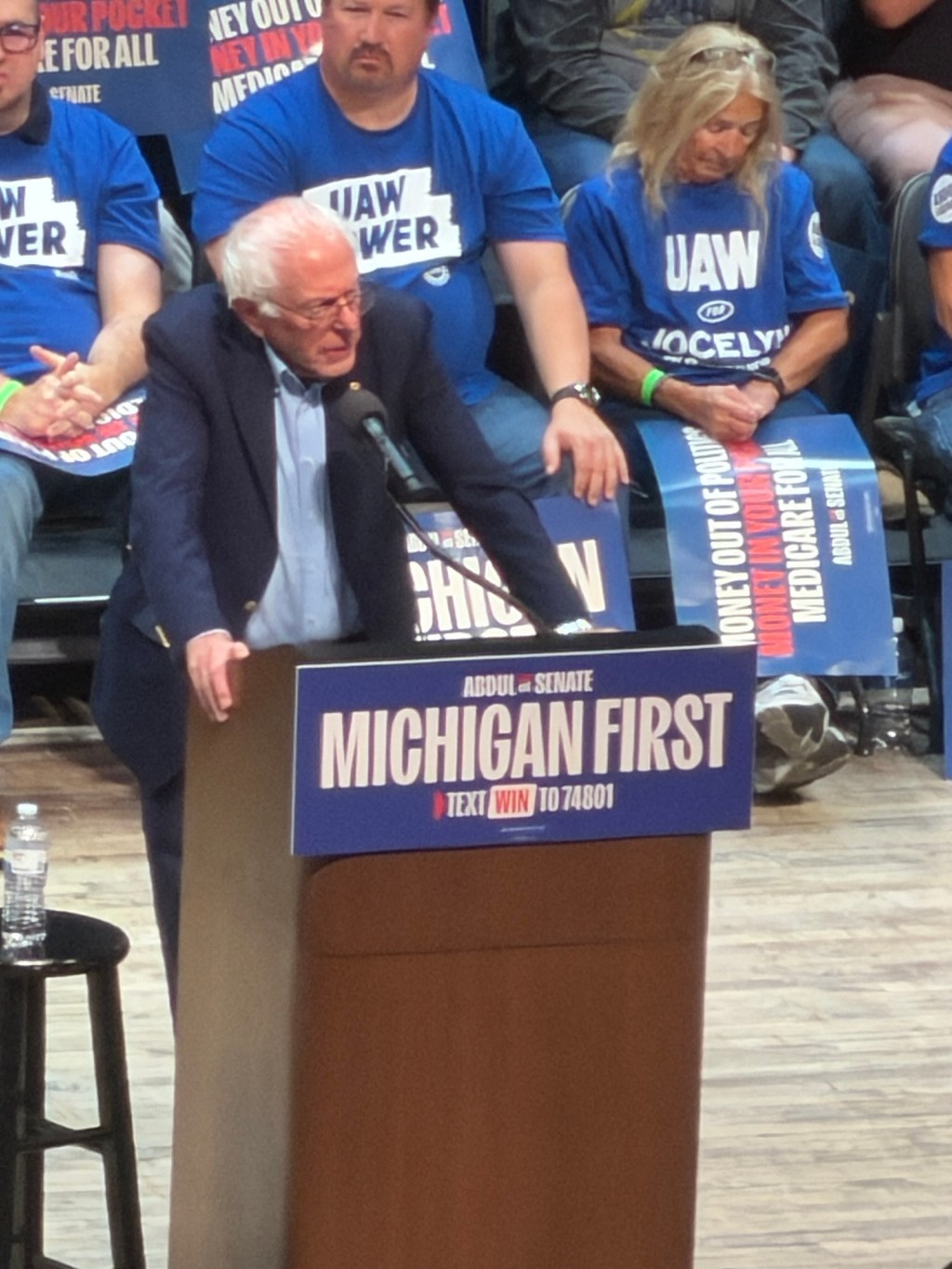
I attended a Bernie Sanders rally, and I want to understand the ideas behind the labels people use. When someone says “socialist” or “communist,” what exactly do they mean? Those words have related histories, but they are not interchangeable.
Before we argue about whether a policy is good or bad, we should be clear about what it proposes. Here is the distinction that helped me sort it out.
What Sanders means by democratic socialism
In his 2015 Georgetown speech, Sanders connected democratic socialism to Franklin D. Roosevelt’s vision of economic rights. In a 2019 speech at George Washington University, he proposed an economic bill of rights covering a living wage, health care, education, affordable housing, a clean environment, and retirement security.
His argument is that political freedom should come with enough economic security to make that freedom meaningful. That explains his priorities; it does not settle questions about whether each proposal would work or how to pay for it.
Socialism is a broad family of ideas
The Internet Encyclopedia of Philosophy identifies social ownership of productive resources as a central socialist idea. Think of businesses, factories, land used for production, and major infrastructure. Social ownership can take different forms, including public ownership or worker cooperatives.
Socialists disagree about markets, planning, and how much power government should hold. “True socialism” is therefore a disputed phrase. It is more useful to ask who owns productive assets, who makes decisions, and how those decision-makers are held accountable.
Democratic socialism: democracy and economic ownership
Democratic socialism belongs within the socialist tradition. It combines the pursuit of social or worker ownership with a commitment to political democracy and civil liberties. The Democratic Socialists of America, for example, explicitly seeks to move beyond capitalism and collectively own key sectors such as energy and transportation. The organization also rejects authoritarian socialism.
That is the organization’s stated position, not a substitute for examining Sanders’s individual proposals. People who share a label do not necessarily share an identical program.
Social democracy: reforming a market economy
In its modern usage, social democracy generally preserves a predominantly capitalist economy while using regulation, labor protections, taxes, and public services to reduce insecurity and inequality. Private businesses and markets continue to operate.
This is where the terminology gets confusing. Sanders calls himself a democratic socialist, but many of his best-known proposals resemble social democratic reforms. That is a comparison of policies, rather than a claim that we can decide his entire political identity for him.
Where communism differs
In Marxist theory, communism’s ultimate goal is a classless, stateless society. Historical communist-party states, however, have commonly concentrated political power in a single ruling party and used extensive state ownership and economic planning. The Oxford Handbook of Political Ideologies distinguishes these institutional features from the movement’s eventual theoretical goal.
Democratic socialism’s commitment to political democracy makes it different from that one-party model. Universal health coverage, by itself, does not make a country communist.
What I want the conversation to be about
Supporters see stronger public guarantees as a way to expand freedom and reduce economic insecurity. Critics raise questions about taxes, bureaucracy, incentives, and concentrated government power. Each proposal deserves scrutiny: What would it cost? Who would pay? What choices would people retain? What evidence suggests it would work?
We can disagree about Sanders and still describe his ideas accurately. Calling every public program communism does not answer those questions. Neither does assuming that a policy will succeed because its intentions are good.



Leave a Reply